Tampilkan postingan dengan label Chrysler. Tampilkan semua postingan

Jumat, 08 Juni 2012

Chrysler 300C

Although instantly recognisable as a motoring icon, the 2012 Chrysler 300C, which goes on sale in the UK on 14 June 2012, is new in every respect. Better built, safer, even more lavishly equipped and more efficient than its predecessor, the new Chrysler 300C retains a unique position in the executive sector. By offering the type of engineering, design, materials and driving dynamics that European buyers expect, combined with American style, personality and value for money, the 2012 Chrysler 300C will appeal to head and heart.
Unlike many rivals which offer a baffling array of engine sizes and trim levels, the new Chrysler 300C, which will become available here in two versions, promises the perfect power output for the car, with two well-judged specifications. The new 3.0-litre V6 turbo diesel benefits from Fiat Group Automobiles' ground-breaking MultiJet 2 technology to provide a class-leading compromise between effortless power and fuel-saving efficiency.
Whether in Limited or Executive guise, the Chrysler 300C is a very well equipped car. Much of the technology that rivals sell as premium priced optional extras feature as standard equipment on the Limited model. Rain Brake Support which helps keep the brake pads dry for better stopping power in poor conditions is unique to this class of car. Ventilated front seats and heated rears, the Uconnect infotainment system with Bluetooth, dual-zone climate control, an 8.4-inch touch screen display, mirrors that darken automatically to limit headlight glare, cruise control, and 18-inch wheels are all standard on the Limited model.

The Executive version has a Blind Spot Monitoring (BSM) system, radar Adaptive Cruise Control (ACC) and a two-panel panoramic sunroof as well as the forward collision monitoring system and 20-inch alloy wheels.
Perhaps the biggest change over its predecessor is the quality of the new Chrysler 300C. By honing every step of the design, engineering and production processes of its new executive model, the American firm has taken a giant step forward in both perceived and actual quality.
The interior has high grade materials throughout, from the redesigned Nappa leather seats to real wood panels on the dashboard. The body is made from a variety of new materials including advanced high resistance and ultra-strong steel. The improved rigidity combined with all-new suspension means the rear-wheel drive Chrysler 300C doesn't just handle better than ever, it's also quieter and more refined too.
The more rigid construction also combines with a suite of nearly 70 electronic safety aids that ensure the Chrysler 300C offers top-class safety in a supremely stylish package.
QUALITY: AMBITIOUS TARGETS MET
The new Chrysler 300C has been designed to take on the best cars in the executive sector in terms of quality. Not only is it crammed with standard equipment, some of it a first for this class of car, it is also superbly built.
Even before build began, the American firm studied rival models covering a spectrum of performance attributes including quality, craftsmanship and refinement. The challenge was then to construct a car that matched or exceeded these levels. To help reach such ambitious targets, the 300C was one of the first Fiat-Chrysler Group vehicles to be examined during the digital design process by a special internal team for 'perceived quality' from the point of view of the most demanding customers.
Build
Perceived quality is the impression given to someone when they look at and touch things. Whether they're sitting in a seat, grasping a steering wheel or simply looking at the fascia, the shape of objects, the materials they're made from and the tactile sensations help people form an opinion of what they see.
In order that the view of the Chrysler 300C would be of a high quality executive car, this internal team worked in close contact with the designers and engineers to improve everything from the assembly and finishes to the quality of the surfaces and materials.
Advanced high-strength steel delivers world-class structural stiffness which leads to exceptional interior quietness, confident handling and outstanding safety performance. Sound suppression inside is further improved thanks to two composite underbody panels that provide more than 2.4 metres of acoustic insulation, a windscreen and front side windows specially designed for their exceptional acoustic performance, triple seals around the doors and special wheel well liners. A laser-braised roof panel and rail sections that deliver a clean, uninterrupted and aerodynamic unibody give further noise reduction.
To ensure this design is implemented in the best possible way, the factory where the 300C is built in Brampton, Toronto, Canada embraces the Fiat Group's World Class Manufacturing philosophy which has rigorous standards for all plant processes from safety and environment to maintenance, logistics and quality. The goal is to improve production performance and quality continuously with built-in flexibility while gradually eliminating waste.
Interior
The Chrysler 300C's cabin has been designed to exude luxury. Instrument and door panels are clad with soft-touch materials chosen to meet Chrysler's strict quality goals. For example, the steering wheel is finished in highly polished walnut and hand-stitched leather. But the stitches have been strategically placed so the driver's hands come into contact only with smooth surfaces.
The instrument panel is treated with the cast skin technique which appears similar to leather, while the seats are covered in Nappa leather. Real wood inserts on the instrument panel, doors, centre console and steering wheel surround further heighten the upscale appearance. The dashboard is finished with discreet chrome touches to emphasise the Chrysler 300C's high quality nature.
All-new seats have been designed to guarantee best-in-class comfort. These feature serpentine spring suspension as their foundation. A stiffer foam material is used in the side upholstery for improved lateral support while less dense foam is used in the lower part of the seats and in the backrest to increase comfort during long journeys. The front seats have four-way lumbar adjustment to suit individual tastes.
To improve rear seat comfort, the front seat backrests have a sculpted shape for about 20cm more knee room. To ensure more foot room, the seat guides are located at the edges of the base.
The interior has a pleasing ambiance thanks to muted Sapphire Blue LEDs. In front of the driver there's a new instrument cluster with two large faces. Features are accented with raised Sapphire Blue tick marks and chromed rings complete the contemporary and premium feel.
The driver also has the all-new Electronic Vehicle Information Centre (EVIC). Again in Sapphire Blue, this has been designed to be easy to read and logically displayed to keep the driver as informed as possible.
As with all roomy and refined interiors, the secret of the 300C's success is having plenty of storage. So that the central armrest is suitable for all shapes and sizes of driver, it slides lengthwise. Beneath it is a sliding tray and a compartment that contains the power connectors for USB devices.
All doors feature oversize pockets with bottle supports and there's a flocked rubber storage compartment with lighting ahead of the gear lever. The roomy glove compartment is split with a shelf and features a centrally mounted light for more uniform light distribution. The two front cup holders, cooled and heated as standard, come with LED lighting that intuitively glows blue when they're chilled, red when hot. They also feature locking rings so they can take bottles of various sizes. As an example of the trouble Chrysler has taken to get the detail of the Chrysler 300C exactly right, the roller closing that covers the front cupholders wasn't just optimised for style and functionality. It was also designed to make a high quality sound when opened and closed.
EQUIPMENT: LUXURY AS STANDARD
As befits a range-topping model, the Chrysler 300C is lavishly equipped, whether in Limited or even more luxuriously appointed Executive trim. And unlike the majority of its rivals the equipment comes as standard.
Everything possible has been done to make the Chrysler 300C an effortless travelling companion. Keyless Enter 'n Go employs electronic sensors to detect the key fob's presence. The car unlocks automatically and the engine starts by pushing a button without needing to insert a key.
The steering column, which adjusts forwards and backwards as well as up and down, has a memory function to allow more than one driver to get comfortable quickly. The pedals too can be adjusted for maximum comfort.
The automatic headlights 'know' when it's getting dark and turn themselves on without any driver intervention. They also feature Adaptive Forward Lighting (AFL) which adjusts the headlight beam up to 15 degrees to the left or right depending on which direction the front wheels are pointing.
To comply with current legislation, Daytime Running Lights (DRL) are standard, using efficient LEDs front and rear and High Intensity Discharge (HID) headlights provide lighting that's three times brighter than regular units. The headlights also employ the SmartBeam system that adapts them to the light in the surrounding environment, ensuring the 300C driver benefits from the maximum light possible without blinding oncoming traffic.
When it rains the automatic windscreen wipers detect drops on the windscreen and start working without the driver telling them to. And the Automatic Temperature Control system measures the humidity inside the vehicle and automatically demists the screen without any driver intervention.
The driver's side door mirror darkens automatically to reduce any dazzling created by the headlights of vehicles behind, as does the internal mirror. Both side mirrors lower themselves when reverse gear is engaged to give the driver better visibility of the ground, kerbs or other obstacles.
The full length dual pane panoramic sun roof, standard on the Executive, has an auto reverse function that can prevent the roof closing if it senses any obstruction. There's an automatic sun blind in the rear window that reduces heat inside the passenger compartment and increases privacy. This automatically lowers in reverse for maximum rear visibility.
Presuming that there are certain areas of the car that executive car buyers would prefer not to touch, the traditional fuel cap is a thing of the past on the Chrysler 300C. Instead the fuel flap opens at the push of a button. A fuel filler pipe opens when the pump nozzle is inserted and closes automatically when refuelling has been completed, helping to protect against theft and vandalism as well as fuel spills and incorrect fuelling.
To avert any danger of breakdown, an Intelligent Battery Sensor continuously measures the flow of current going to and from the battery. If it detects that the battery is running down it disables the less critical electric systems and warns the driver.
Uconnect
The Chrysler 300C features the company's advanced Uconnect infotainment system of on-board technologies that ensures driver and passengers remain connected, safe and comfortable.
This system displays all the information the driver or passenger requests on an 8.4-inch touch screen, the largest in this car's class. With its multimedia and portable mobile device connectivity, it is specifically designed to enrich the experience of driving and travelling in the Chrysler 300C.
For maximum safety and ease of use, audio and connectivity controls are located on the spokes of the steering wheel and can be activated hands-free by voice alone. Uconnect Voice Command with Bluetooth lets the driver manage a Bluetooth compatible phone while keeping both hands on the steering wheel. The first time the phone is synchronised, the phonebook is downloaded on to the car's hard drive and numbers can be selected simply by saying the corresponding name.
Voice commands can also be used to select the available radio modes. In the arm rest there's a USB port with iPod control. This lets the driver run an iPod or similar mobile device either through the steering wheel controls or using the touch screen. The USB port allows any USB supplied device to be recharged and will play audio files stored in MP3 and WMA format on a USB drive.
The touch screen controls the single DVD player, an SD card reader, the automatic dual-zone climate control, the radio and the Garmin navigation system. This has clear maps and optional voice instruction along with suggested points of interest, making it easy to find restaurants, shops and hospitals in the area.
There are three levels of audio system. The Limited version's standard sound system has six speakers with a 276 Watt six-channel amplifier. Two 3.5-inch speakers are in the instrument panel, two 6 x 9-inch speakers are set in the front doors and two are in the rear parcel shelf. A nine-speaker Alpine system is optional. This has an 11 channel amplifier with 506 Watts of power plus digital signal processing with 7.1 surround sound. It features three 3.5-inch speakers in the instrument panel, two 6 x 9-inch speakers in the front doors, two 3.5-inch speakers in the rear doors, two 6 x 9-inch speakers in the rear parcel shelf, plus an 8-inch subwoofer in the rear parcel shelf.
This system is standard on the Executive model, while a 19-speaker Harman Kardon sound system is optional. This sophisticated 900 Watt device has a 12-channel Harman Kardon amplifier. There are six 3.5-inch speakers in the instrument panel, two 6 x 9-inch speakers in the front doors, four 3.5-inch speakers in the rear doors, two 6 x 9-inch speakers, four 3.5-inch speakers and a 10-inch sub woofer in the rear parcel shelf.
ENGINE: EFFORTLESS AND EFFICIENT
The 2012 Chrysler 300C comes with one engine for the UK, an all-new 3.0-litre V6 turbo diesel designed to be big on efficiency, refinement and power, which made its UK debut in the new Jeep Grand Cherokee last year.
Built by VM Motori and developed by Fiat Powertrain, this engine is a new design employing Fiat's latest MultiJet 2 technology to help reduce consumption, emissions and noise while yielding class-leading pulling power.


The 236bhp unit produces a healthy 540Nm of torque, peaking between 1600 and 2800rpm for effortless progress. A single variable geometry Garrett VGT 2056 turbocharger with intercooler ensures the engine is smooth and responsive at all speeds and yields a 0-62.5mph time of 7.4 seconds and a top speed of 144mph. But the engine is so efficient it can return 39.8mpg on the Combined Cycle and emits 185g/km of CO2.
With a capacity of 2987cc, the engine has a 60-degree V angle giving compact dimensions of just 695mm long, 729mm wide and 697.5mm high. A graphite cast iron block with aluminium cylinder heads and a structural aluminium oil sump in two elements help contribute to a total engine weight of 230kg. The sump has been designed like this to increase the rigidity of the engine for improved quietness. Noise is reduced further thanks to a new crankcase that gives the forged steel crankshaft rigid support to help limit vibrations.
The engine features four valves per cylinder and has a compression ratio of 16.5:1 to give cleaner combustion and more power. The six shell-cast aluminium pistons are lightweight and have been designed to minimise friction. The main bearing supports are lead-free to guarantee less environmental impact both during production and when the engine is recycled after use. Combustion is further optimised thanks to a turbulence control system fitted between the intake system and combustion chamber. This supplies the best flow of air through the combustion chamber to optimise engine efficiency and reduce exhaust emissions.
As with the Fiat Group's award-winning smaller engines, the 3.0-litre employs the latest second-generation MultiJet turbo diesel technology. The common rail injection system operates at 1800 bar while faster injectors give up to eight injections per cycle, meaning greater speed, flexibility and precision in the various combustion phases. It's also capable of injection rate shaping - that's two injections that are so close together they generate a continuous but modulated supply of fuel to the cylinders. This alone reduces consumption and polluting emissions by 2 per cent compared with traditional fuel injection, and also cuts down engine noise.
Improving the combustion process like this reduces particulate and nitrogen oxide (NOx) emissions sufficiently to ensure the engine complies with strict Euro 5 legislation.
The new Chrysler 300C features a five-speed automatic transmission. The tried and tested W5A580 has both full automatic and semi-automatic functions. As with a traditional automatic, once 'Drive' has been selected the gearbox can be left to do its own thing. For drivers who want more involvement, the AutoStick function allows them to select higher or lower gears and steering wheel mounted paddles are standard on the Executive. A transmission controller is calibrated to prevent the engine over-revving while an adaptive electronic control increases engine responsiveness.
SAFETY: BUILT IN FROM THE BOTTOM UP
The new Chrysler 300C is one of the safest cars on the road, with a host of standard equipment that ensures driver and passengers travel in maximum security. To guarantee this, the 300C was tested in a variety of accidents including front and side impacts, roll over, pile up and fire. Different impact speeds, different types of obstacle and the different physical characteristics of passengers were also taken into account. The result is a car that combines the latest in active and passive safety devices with one of the safest structures on the road.
Preventative safety
The most important thing when it comes to avoiding an accident is being able to see danger. In designing the Chrysler 300C, the windscreen header was moved back by just under 8cm to improve the driver's view of road signs and traffic lights. Combined with narrower pillars the result is an improvement in outward visibility of 15 per cent.
But in case the driver doesn't see hazards, the car has been designed to step in. Adaptive Cruise Control (ACC) on the Executive uses radar to automatically modify the Chrysler 300C's speed to keep a safe distance when the car approaches another vehicle in the same lane or when another vehicle enters that lane. When the vehicle in front moves out of the way, the cruise control automatically returns to its set speed. It means the driver doesn't constantly have to alter the cruise control to match prevailing conditions.
The 300C Executive is fitted with Blind Spot Monitoring (BSM). This uses ultra broadband radar sensors to search for vehicles that might be briefly concealed from the driver's view. Icons illuminate in the mirror and an acoustic warning signal sounds if there is a car in the blind spot.
Forward Collision Warning (FCW) on the Executive employs radar sensors located in the front to check the Chrysler 300C's approach speed to vehicles. If it is travelling too quickly the car will alert drivers so they can take the necessary steps to avoid an accident.
Rear Cross Path Detection (RCP) is enabled when reverse gear is engaged. This informs drivers via icons in the mirror and an acoustic signal if traffic is approaching as they reverse out of parking spaces. ParkSense helps detect stationary objects behind the car and warns the driver with an acoustic signal. For further peace of mind the 300C is equipped with the ParkView reversing camera. This offers a wind-angle view of the area immediately behind the vehicle on the navigation screen.
To ensure the driver is never caught out by low pressures, Tyre Pressure Monitoring employs sensor modules in the valve stems of each wheel to send signals to the in-car computer. Proving the Chrysler 300C doesn't only look after its occupants, it has Active Pedestrian Protection where the rear of the bonnet lifts in a frontal impact to protect the pedestrian's head from hard points in the engine bay.
Active safety
Obviously the safest thing is to avoid having a crash in the first place. Consequently the Chrysler 300C has been designed not only to have predictable handling but also to compensate for any mistakes that the driver might make.
Standard equipment includes a powerful braking system allied to some of the most sophisticated electronic driver aids available today. High performance brake pads have been designed to give regular, fade-free performance. Vibration dampening springs make the callipers more efficient and there's a hydraulic pressure compensation system that intervenes by activating the ABS pump to the maximum if it detects a fault in the brake servo.
The Chrysler 300C has an Antilock Braking System (ABS) that detects and prevents wheels locking in extreme braking conditions or on slippery surfaces. It also features bumpy road detection which can sense a rough stretch of road and activates the ABS with slightly different pressure control to compensate for the surface.
The Chrysler 300C has two new attributes that are exclusive to this class of car. Ready Alert Braking can predict if the driver is starting emergency braking and uses the Electronic Stability Control (ESC) pump to move the brake pads closer to the rotors and reduce the time for the brakes to be applied. Rain Brake Support performs the same function when it's raining to keep the brake pads dry for improved braking performance.
Stopping is further aided by Braking Assistance which applies maximum braking power in emergency situations. At the same time a signal is sent to the engine computer telling it to reduce power if the accelerator is still being pressed.
The standard ESC helps to increase the amount of control the driver has in all conditions. By monitoring steering inputs whatever the surface, the ESC computer can tell if the car deviates from its intended path and steps in to brake selected wheels. It also controls the Hill Start Assist (HSA) which maintains braking pressure for a brief period after the driver lifts off the brake to ensure the perfect hill start every time. The braking system works to help aid efficient acceleration too. By applying the brakes when it detects wheels are slipping, it ensures maximum power is transmitted to the road.
Passive safety
Inside the new Chrysler 300C there are seven passenger airbags including the latest multi-stage bags that open with more or less force depending on the seriousness of the impact. The driver's airbag is shaped to reduce the impact force and therefore chest injuries, while the passenger airbag opens at a varying speed depending on how far back the occupant is sitting.
Housed in the roof lining above the side windows are curtain airbags. Each has its own impact sensor for independent activation on the impact side. Beneath the instrument panel is a knee airbag that deploys when the driver's side airbag goes off. The aim of it is to ensure the driver's legs are in the best position to minimise injuries in a frontal collision. As with the curtain airbags, the thorax bags installed in the external edge of the front seats have their own impact sensors for independent activation. These are designed to reduce injury to the pelvis and chest in side impacts.
All airbags are governed by the Occupant Retaining Controller. This determines whether an impact is strong enough for the airbags to open and whether first or second stage deployment is required. It also decides whether the side airbags are needed and controls the seatbelt pretensioners.
Driver and front passenger have height adjustable seatbelts for greater comfort and safety and their seatbelts are fitted with pretensioners. Controlled by impact sensors, these tighten the seatbelts before an impact to help minimise injuries. In the milliseconds after impact, Constant Force Restraint checks how tightly occupants are being held by their seatbelts and gradually reduces this in a controlled way. A warning light illuminates and a tone sounds if any passengers don't fasten their seatbelts. The 300C is fitted with active head restraints which, in a rear impact, move forward to reduce whiplash injuries by decreasing the distance to the occupant's head. All five passengers have their own head restraint and three-point seatbelts.
Passengers are also protected by a safety cage structure, door protection bars and controlled crumple zones designed to absorb the energy of an impact and reduce the effect it has on passengers. The driver benefits from a new energy absorbing steering column. This uses a calibrated bent element to deform during an impact and direct crash energy away from the driver.
In the immediate aftermath of a crash the Enhanced Accident Response System helps emergency personnel by automatically illuminating the interior lights, engaging the hazard warning lights and unlocking the doors once the airbags have deployed. It also interrupts the flow of fuel going to the engine.
HANDLING: DESIGNED FOR DRIVER APPEAL
Some of the same characteristics that make the Chrysler 300C safe and comfortable also go towards making it an excellent driver's car. The near 50-50 weight distribution gives the car balance, but drivers can really exploit that thanks to use of advanced steels and nylon composite materials that contribute to greater rigidity and therefore improved control and confidence.
More than 67 per cent of the 300C's underbody structure and 53 per cent of the upper part of the body is pressed and built with high resistance and advanced high resistance steels. High resistance steel is found in the central tunnel, in the body sides, in the front wheel arch structures and in the crash protection bars. With a tensile strength twice that of high resistance steel, advanced high resistance steel is used for areas of the body that require greater structural rigidity such as the cross members of the seats and the upper rear area behind the back seats.
Hot pressed ultra-strong steel is used for the front pillars, the doors, the upper section of the front rails and windscreen channel. And thanks to its tensile strength the thickness of the pillars and doors was able to be reduced, helping to improve external visibility. Lightweight and thin dual-phase steel is used for the interior of the front crash bars and engine compartment to achieve optimum protection for the Chrysler 300C's passengers.
The upper monocoque is built in advanced TRIP (Transformation Induced Plasticity) steel. TRIP steel allows a thinner and lighter weight steel to be used for the areas of the B pillar, while reinforcements in composite nylon have been built into the A and B pillars to provide greater crash protection.
New front and rear suspension geometries are light in weight yet have an ultra rigid assembly in order to guarantee precision and performance. The new front single tube shock absorbers, the new springs and the unique position of the shock absorber and front suspension mounting all contribute to the optimum control, driving and comfort ratings. New high quality hydraulic bushes in the front suspension limit roughness and help transmit braking power to the road.
The rear suspension is characterised by five anchoring points and roll steer geometry for better handling. The new single tube shock absorbers and springs make driving more polished, while high quality urethane compression bump stops, and suspension anchoring with rubber bushes for the shock absorbers, make the passenger compartment quieter. Even the seat springs have new dampers to help isolate passengers from vibrations over bumpy roads.
New geometries for front and rear cambers improve cornering performance and road feel by having the upper part of the wheel tilt inwards in relation to the body. And new large diameter front and rear anti-roll bars give greater agility through corners and limit body roll. The suspension has been tuned specifically for European roads and this combines with load levelling suspension on both versions to ensure unruffled progress.
Revised Electro-Hydraulic Power Steering (EHPS) gives the driver precise feedback from the road, improves steering alignment and reduces steering noise and fuel consumption. The EHPS system analyses steering angle, vehicle speed, engine speed and the chassis control systems 13 times a second to decide how much steering effort is required. When stationary or at low speed, the hydraulic pump increases the power steering to reduce effort. At higher speed, assistance is reduced to give the 300C's driver more feel. The result of this is lower consumption than a belt pump and a reduction in fuel consumption by 1.5 per cent.
STYLING: AMERICAN BEAUTY
Ever since it was first launched internationally in 2003, the Chrysler 300C has been an iconic design statement, and the new model is no different. Boasting generous dimensions that are 5066mm long, 1488mm high, 1902mm wide and with a wheelbase of 3052mm, the 2012 model builds on the unmistakeable proportions of its predecessor with a more refined and tailored design.
At the centre is Chrysler's new wing badge which has been remodelled to have a more modern appearance. Its shape is echoed by the grille surround and carries on into the sculpted bonnet. Exterior design details include a dramatically sculpted front bumper and horizontal chrome grille blades. Showing how style and functionality go hand in hand, powerful bi-xenon headlamps are in a stylish 'key slot' shape. Beside them, LED Daytime Running Lights (DRL) create a unique C that gives the 300C an unmistakeable presence on the road.
The characteristic silhouette is crisp, clean and refined with the more steeply raked windscreen lending it an aerodynamic appearance. Marked wing lines front and rear that are higher than the bonnet and boot they embrace, emphasise the spaciousness of the passenger compartment. Combined with 20-inch aluminium wheels on the Executive, they give the car a sporty low-to-the-ground appearance. Convex doors are stylishly embellished with chrome-plated door mirrors, while the fixed window on the rear doors helps contribute to improving external visibility.
At the rear, vertical LED tail lamps are connected by a chrome fascia accent. The boot sports a built-in spoiler while the Chrysler 300C's performance prowess is hinted at by twin oval tail pipes that are integrated into the rear valance.

Jumat, 30 September 2011

Chrysler Delta

The new Chrysler Delta, which is now on sale in the UK, is all about adding value to people's lives. It offers family saloon space in a compact hatchback body. It introduces executive car equipment to a wide market. It features sophisticated technologies that are entirely new to this size of car. And it presents all this at prices, starting at just £16,695 OTR, that equal or undercut many less gifted rivals.
With its sophisticated appearance, sumptuous interior and four state-of-the-art engines, the Delta is an accomplished re-entry into the C segment for Chrysler. On sale here now, it provides the sort of interior space expected from a far larger vehicle. Yet a host of all-new electronic driver aids ensures that the Delta is satisfying to drive as well as being very comfortable for both front and rear seat passengers.

Along with its smaller sister, the new Chrysler Ypsilon, Delta marks the resurgence of Chrysler Group LLC, which was formed in 2009 as a strategic alliance with Fiat. Chrysler's portfolio contains some of Europe's most recognisable vehicles, including the 300C saloon and top-selling Grand Voyager MPV. Now with the help of Fiat's experience and knowledge in the small and medium-sized car sectors, Chrysler can infuse compact, more environmentally friendly models with the luxurious character traits of its bigger cars.
Chrysler brand director Nigel Land says: "People know us for large vehicles such as the Grand Voyager and 300C. We are transferring the values that lie behind those cars to the B and C segments. We are not going for high volumes. We want to be the choice for people who are seeking a credible alternative to traditional segment offerings.
"The Delta will bring D-segment standards of space and quality to the C-segment. This is just the start of our journey as we re-launch the Chrysler brand in the UK. We are now starting to sell cars that are relevant to a more mainstream market. They'll have all the quality features you would expect from a large Chrysler, integrated into very stylish European designed interiors."
The Delta has already made a promising start, with CAP predicting strong residual values. Part of this is down to the expectation that buyers will welcome some of the features it introduces to the family hatchback sector. The rear seat slides for maximum versatility and when it's in its rear position there is a class-leading 1010mm of leg room in the back. Passengers can recline the seat back up to 25 degrees for extra comfort. And there are a host of 'large car' technologies available, such as Magic Parking, Lane Departure Control and Blue&Me™.

The theme of versatility embues the entire Chrysler Delta range. There are four trim levels: S, SE, SR and Limited. There are four engines too, starting with a lively petrol 1.4-litre TurboJet and a more powerful 140bhp 1.4-litre that uses Fiat's ground-breaking MultiAir technology. These are supplemented by a pair of potent yet economical diesels, in 1.6-litre and 2.0-litre capacities, which benefit from second generation MultiJet technology. All models feature six-speed gearboxes with a semi-automatic version available on the 1.6 SE MultiJet.
Standard equipment is satisfyingly high. Even the range-starting S model offers a radio/CD with MP3 compatibility, front foglamps with cornering function, remote keyless entry, manual air-conditioning and power windows front and rear. And the range-topping Limited model comes with Blue&Me™, a Navigation system, headlamps with dusk sensors, reclining rear seats and leather upholstery.
Safety comes as standard throughout the Delta range, so all models are equipped with Daytime Running Lights (DRL), six airbags, three-point safety belts for all five seats, ABS anti-lock braking with Electronic Brakeforce Distribution (EBD), Electronic Stability Control (ESC), Hill Holder and Anti Slip Regulation traction control. It also incorporates Linearisation Torque Feedback (LTF), Torque Transfer Control (TTC) and Drive Steering Torque (DST), all of which are designed to improve handling.
STRIKINGLY SOPHISTICATED
Drivers looking to make their mark without spending a small fortune will appreciate the new Chrysler Delta. Handsome, dynamic and sophisticated, the striking modern design ensures it stands proud of more conservative rivals, and yet is very competitively positioned.
At the front, high tech projector style headlamps are instantly recognisable because they feature bright LED Daytime Running Lights (DRL) as standard equipment. Front fog lamps with cornering function also come with every model and sit either side of a front air intake designed to give the Delta a sporty look. Combined with Chrysler's newly styled shield grille and neatly sculpted bonnet, it makes for a stylish alternative to the mainstream.
With a high waistline rising to the rear, the Delta has an equally sporty stance from the side, helped by the standard rear spoiler that blends into the rear window. A sophisticated appearance at the back is set off by a rear window that has no surrounds and is flanked by curved, vertical LED tail lights.

SPACIOUS TRAVEL
The Chrysler Delta has been developed to offer driver and passengers the levels of on-board comfort they might expect from a much larger, much more expensive car.
The first thing that will strike anyone slipping inside the Delta is the sheer space. In size terms, with its 2700mm wheelbase and 4520mm overall length it sits at the larger end of the C segment. But inside it has the kind of room you're more likely to find in a D or even E segment model.
Chrysler has employed techniques usually found in MPVs to make this space as flexible as possible. Unusually for this sector, the rear bench slides backwards and forwards (not on Limited versions). It means owners can choose to increase boot space, if for example they have small children in the rear seats, or give rear seat passengers limousine levels of leg room.
With the back seats in their forward position the Chrysler Delta still offers rear passengers a remarkable 930mm of leg room. With the rear seats in their most forward position, the boot offers 465 litres. And even when the backrest is as far back as it'll go there's still a healthy 380 litres. The boot also features a small space under the floor. This provides a hidden compartment for valuables and means that when the seats are folded down, the 1190 litres of space has a continuous flat floor.
The rear seats don't just slide, they recline 25 degrees backwards too, offering passengers impressive comfort options. This is further emphasised by the quality of the fabrics used inside, which present owners with the sort of high-class materials and build quality they'll be more used to in much more expensive models. This should appeal to buyers who are downsizing, one of Chrysler's target markets.
Materials such as leather and Alcantara are used extensively, while on lower trim levels the dashboard is covered with Benova, a soft premium textile. This is the first time Benova has been used on such an accessible vehicle; until now it's been reserved for prestige brands. On Limited versions the dashboard is covered in Poltrona Frau Leather.
The range-starting S model has premium fabric covered seats while in SE variants they're cloaked in Carbony 3D fabric. This high-tech cloth has a three dimensional effect and features contrasting Alcantara inserts. The SR has Alcanatara with leather inserts, while the top of the range Limited comes with full leather trimmed seats finished with classic piping round the edge for an authentic executive feel.
The dashboard has been designed to feel substantial without being too imposing. Centre console buttons are illuminated by a white light for quick and easy identification. Elsewhere, elements of the cabin are aimed at the driver−such as the centre console, steering wheel and instrument surrounds that are highlighted by a metallic-effect Satin Silver paint.
The sophisticated feel of the Delta's cabin is reinforced by thoughtful detailing throughout. Chrome finishes are used on the door handles, radio, climate control knobs and dashboard. The front seats on SE, SR and Limited models have the new Chrysler logo on the head restraints. The glovebox and grab handles both have the slow sprung return you associate with refined cars. And the roof is lined with a new polyester-based material that reduces cabin noise on the move.
It's not just in comfort terms that the Chrysler Delta has been designed to excel. It's also had safety engineered into it from the ground up. The result is that it's won a European New Car Assessment Programme (EuroNCAP) five star crash safety rating. This is thanks to six airbags fitted as standard (front, window and curtain bags on both sides), and five three-point safety belts, with load limiters and pretensioners fitted to the front seats.
In addition to that, the Delta is packed with standard equipment to make driving as safe possible. It comes with ABS anti-lock braking and Electronic Brake Distribution (EBD) to ensure maximum stopping power is deployed in an emergency situation. Powerful disc brakes are used front and rear, and in an emergency stop the hazard lights are automatically switched on.
WHERE SAFETY, FUN AND COMFORT COMBINE
It's not just the Chrysler Delta's generous level of interior space that has the hallmark of an executive car. Its sleek shape also cloaks the kind of large-car equipment levels that until now haven't been available to drivers buying a mid-sized family hatchback.
Designed to ensure that the Delta tops the class when it comes to comfort, safety and driving dynamics, innovative technology has been used from the very earliest design stages.
Absolute Handling System and Drive Steering Torque
To enable drivers to make the most of their Chrysler Delta, it's been fitted with some pioneering electronic systems to make life at the wheel more enjoyable yet even safer. Prime among these is the Absolute Handling System. This is an amalgamation of various existing technologies such as Electronic Stability Control (ESC), Hill Holder to ensure perfect hill starts every time, Anti Slip Regulation (ASR) which uses brake and engine control to optimise traction at any time, and MSR which cuts in to ensure engine torque isn't interrupted if a swift down change is needed during a climb.
Where the Absolute Handling System really stands out from the crowd is by encompassing Linearisation Torque Feedback (LTF), Torque Transfer Control (TTC) and Drive Steering Torque (DST) in its suite of skills.
The new DST is an electronic steering system that suggests the moves drivers should carry out to maximise road holding and therefore security. It does this through generating torque at the steering wheel courtesy of a continuous interaction between the electric power steering and the Absolute Handling System which controls the car's dynamics. The DST means that if the car begins to oversteer, the most appropriate manoeuvre to maintain control is 'suggested' to the driver.
The DST also has a Mu-Split Control Function (MCF) which works over surfaces with different levels of grip. This enables automatic countersteering to prevent the vehicle from spinning and reduces braking distance by 10 per cent.
The LTF comes to life when it detects high lateral acceleration. Assuming this to be the result of sporty driving it boosts the steering wheel's resistant torque to improve road feel for the driver, particularly through fast bends.
The Delta also features a new TTC system designed to improve the transfer of torque to the driven wheels. When the driver accelerates through a bend, the brake is constantly modulated on the inner front wheel to increase traction to the loaded outer wheel. By distributing torque between the front-driven wheels in this continuous dynamic manner, it simulates the behaviour of a Limited Slip Differential to give the driver a feeling of improved agility and better traction.
Generously equipped
As well as being packed with systems designed to make it more comfortable, safer and better to drive, the Chrysler Delta features a generous level of standard equipment. Even in standard S guise it comes with a radio/CD with MP3 files compatibility, air conditioning, adjustable steering wheel with audio controls, power windows front and rear, and 'follow me home' headlights that delay switching off.
The SE model features trim enhancements such as a quality finish to the dash and doors, a refrigerated compartment in the cabin, chromed door handles and window surrounds, and 16-inch alloy wheels. The SR builds on that with two-zone automatic climate control, Alcantara leather upholstery, Cruise Control and 17-inch alloy wheels. Options include a panoramic sunroof that takes up 80 per cent of the total roof space, a Bose Audio System and an electrochromatic dimming rear view mirror.
Navigation Versions
Both SE and SR trim levels of the Chrysler Delta also feature Nav versions which come equipped with Blue&Me™ Nav. The result of a joint venture between Fiat and Microsoft, this extremely simple-to-use system allows drivers to manage their music and phone calls easily and safely, using either voice controls or buttons on the steering wheel.
Blue&Me
Delta owners can make calls and play music the way they want with Blue&MeTM, developed in conjunction with Microsoft.
It works via Bluetooth®, so users can safely stay connected while they are driving. The buttons on the steering wheel are easy to use to answer and make a call. There is also voice recognition, allowing calls to be made and connection within seconds.
As soon as users of Blue&MeTM receive an SMS text message, it notifies them. And at the push of a button or by voice command, the message will be read out over the car's speakers.
For playing music, users can plug in their USB stick or MP3 player into the port provided to get their favourite music at their fingertips, or by voice command.
The buttons on the steering wheel allow the driver to skip through albums or tracks which are shown on the dashboard display. Alternatively, voice command technology allows operations via simple voice commands like 'Next', 'Previous' and 'Play'.
Nav
The navigation system has a 6.5" colour screen, voice recognition and SD-card map management. Map updates are possible through the NAVTEQ MAP CARE programme.
Both Blue&MeTM and the Navigation System are standard on Nav versions and are also standard on Limited (*Nav versions are available on the SE and SR trim levels).
As well as this, the range-stopping Limited model is fitted with parking sensors, dusk sensors and a tyre pressure monitoring system. This car's top model status is highlighted by gold exterior 'D' badges replacing silver on the B-pillar, twin chrome exhaust tail pipes and unique 17-inch alloy wheel designs.
Magic Parking
The larger the car, the more difficult finding a parking space can be. Chrysler provides a solution to this problem with its optional Magic Parking.
Pushing a button on the dashboard activates the system which then uses radar sensors mounted in the front and rear bumpers combined with wheel speed sensors to measure the length of empty parking spaces. If it detects one that is free from obstacles and is long enough to accommodate the car, the driver is informed by a beeping noise and a message on the dash. If the driver decides to park in it, the car's computer takes over the steering to carry out the reverse parallel parking manoeuvre. The driver retains control of the accelerator and brake and is permitted a speed of just over 4mph. The driver can deactivate the system at any time, either by turning the wheel, changing out of reverse or pressing the button on the dashboard.
Lane Departure Control
Today's roads are so crowded that another pair of eyes always comes in handy. And that's exactly what the Chrysler Delta's optional Lane Departure Control provides.
The main element of this is a TV camera with image-processing software. This sends data on the geometry of the road in front of the vehicle to the onboard computer enabling the car to 'recognise' road markings. The car's control unit then decides what sort of steering inputs are needed to keep the car within the lines on the road. If these aren't applied and the car starts to drift out of its lane, a motor generates torque on the wheel to tell the driver which direction they need to steer to stay in the lane. It only intervenes if the car starts to change lanes without indicating. The driver can override it at any time.
DELTA FORCE
The Chrysler Delta benefits from Fiat Powertrain Technologies' (FPT) experience of designing, developing and building small, yet highly efficient and powerful award winning engines. Whichever one of the two petrol and two diesel engines buyers choose, they can be sure of optimum fuel economy and impressive torque.
1.4 litre Turbo-Jet − Petrol
Giving a combination of sporty refinement and great value, and developed as part of the FIRE (Fully Integrated and Robotised Engine) range of engines, this power unit guarantees the best possible performance for the lowest possible fuel consumption (44.8mph Combined Cycle), and a 2 year/18,000 mile service interval helps to make this a highly economical choice.
1.4 litre MultiAir
The second engine in the Delta range is a more powerful 140bhp 1.4 litre petrol which utilises FPT's award-winning MultiAir technology.
MultiAir technology works by allowing the direct metering of air stroke-by-stroke, cylinder-by-cylinder through the intake valves without using the throttle. The benefits of this technology are wide ranging: - maximum power is increased by up to 10% because of the adoption of a power-orientated mechanical camshaft profile; and low-end torque is improved by up to 15% through early intake valve closing strategies that allow maximisation of air mass in the cylinder. By eliminating pumping losses, a 10% reduction of fuel consumption and CO2 emissions is achieved over naturally aspirated and turobcharged engines not using MultiAir technology. Optimised valve control strategies during warm-up and internal Exhaust Gas Recirculation (iEGR, which is realised by re-opening the intake valves during the exhaust stroke) mean that substantial HC/CO and NOX reductions can also be achieved.
MultiAir technology combines to allow this engine to exceed the excellent MPG of the 1.4 Turbo-Jet, achieving 49.6mpg (Combined) with significantly higher BHP and torque figures.
1.6 MultiJet 120bhp
The first diesel engine in the Chrysler Delta range is a 120bhp FPT developed MultiJet available to customers purchasing Delta SE and SR versions, with a 6 speed semi-automatic transmission available on SE versions.
MultiJet is another ground-breaking development from FPT which in this latest guise allows eight injections per combustion cycle. This is possible due to the new MultiJet II injector patented by FPT, and integrated into the ECU by Magneti Marelli. The shutter in the injector is hydraulically balanced, which allows a larger sealing diameter, with reduced shutter strokes. This servovalve allows fuel quantities to be injected into the combustion chamber quicker, and with greater accuracy.
The shutter stroke has been reduced to 20µm (microns), which has allowed the interval between two consecutive injections to be dramatically reduced. This allows the injection rate to be modulated, to achieve greater combustion process control. This new injection mode is called Injection Rate Shaping. The results are reduced noise, fuel consumption of 60.1mpg (Combined) and reduced pollutant emissions.
When a customer chooses the semi-automatic transmission, the benefits of MultiJet technology are amplified, with 61.4mpg (Combined) and 120g/km CO2.
2.0 MultiJet 165bhp
The most powerful engine in the Delta range is available exclusively on the Delta Limited. Customers can thus enjoy the most luxurious trim level with the most appropriate engine.
The 2.0 MultiJet features all of the MultiJet technology available on the 1.6, but in a more potent package, offering 165bhp and 360Nm of torque. Economy figures are still impressive at 55.4mpg (Combined) with CO2 emissions at 135g/km.

Rabu, 28 September 2011

Mercedes C-Class Coupe

The expressive Mercedes C-Class Coupé sees Mercedes-Benz, now in its 125th year of corporate history, entering a new market segment and for the first time offering a compact, classic coupé. This youthful, sporty two-door car was unveiled at the 2011 Geneva Motor Show.
The new model deploys the progressive technology featured on the soon to be launched new generation of the C-Class to deliver an impressive coupé format that combines pure fun at the wheel with exemplary efficiency. In terms of attitude, this debuting model is tailored to a customer group aged 35 to 45 for whom professional success, love of life and a strong sense of responsibility are all important.
"By extending the C-Class portfolio, we are consciously targeting new customers," says Dr Joachim Schmidt, Head of Sales and Marketing at Mercedes-Benz Cars.


"The new model is youthful, stylish and dynamic. What we are offering is an exceptionally sporty way to enter the world of the Mercedes-Benz coupé."
The design: dynamic with classic coupé proportions
From the side, the new coupé beguiles the onlooker with its compact proportions, low silhouette (41 mm flatter than the saloon) with powerful shoulders and a narrow C-pillar in a classic three-box design. Typical coupé features include the short front overhang, long bonnet, steeply raked windscreen and long, stretched out roof. The cabin extends far beyond the rear axle over the rear window in its flat position to a sportily short tail end.

Jumat, 02 September 2011

Audi S7 Sportback

The Audi S7 Sportback uses the same engine as the S6 and S6 Avant, the new 4.0 TFSI with 309 kW (420 hp) and 550 Nm (405.66 lb-ft) of torque. The twin-turbo V8 accelerates the five-door coupe from 0 to 100 km/h (62.14 mph) in 4.9 seconds, and top speed is limited to 250 km/h (155.34 mph). The cultivated eight-cylinder, which uses Audi's "cylinder on demand" technology under part load, consumes on average just 9.7 liters of fuel per 100 km (24.25 US mpg).
Much of this groundbreaking efficiency can be attributed to the lightweight body. A hybrid aluminum construction, it weighs roughly 15 percent less than a comparable all-steel body. Lightweight components include the long rear hatch that opens and closes electrically as standard. Beneath it is a luggage compartment with a volume of 535 liters (18.89 cu ft), which increases to 1,390 liters (49.09 cu ft) with the rear seat backs folded down.
Drivetrain and chassis
Power transmission in the Audi S7 Sportback is provided by the dynamic seven-speed S tronic and the quattro permanent all-wheel drive system with a self-locking center differential and torque vectoring. The optional sport differential from Audi distributes the power in variable proportions between the rear wheels.
The Audi S7 Sportback comes standard with the adaptive air suspension sport and the Audi drive select dynamics system. Mounted behind the 19-inch wheels are large, internally ventilated disc brakes front and rear. Their matt black calipers sport S7 logos up front. Carbon fiber-ceramic discs are available as an option.
Other chassis options include 19- and 20-inch wheels and dynamic steering, which varies its ratio as a function of speed.
Body and design
The design of the Audi S7 Sportback is seamless. The long engine hood, the long wheelbase and the short overhangs create perfect proportions. The low, dynamically tensioned roof line gives the five-door model the character of a coupe. At highway speeds, a rear spoiler extends from the rear hatch to improve stability.
Subtle yet eye-catching details signal the top position in the model series occupied by the 4,980-millimeter (16.34 ft) Audi S7 Sportback. These can be found at the single-frame grille, the front bumper, the side mirrors, the sills, the rear bumper, the diffuser and the tailpipes. Nine exterior colors are available, including the exclusive shades Estoril Blue, crystal effect and Prism Silver, crystal effect. The body is decorated with S and V8 T badges.
Interior
The Audi S7 Sportback shows its sporty character in the interior, too. This can be seen in numerous details - the S badges, the red ring on the start-stop button, the S7 logo in the illuminated door sill trims, the aluminum strip on the S tronic selector lever and the aluminum shift paddles. The footrest and the pedals are made of stainless steel, and the soft keys of the MMI operating system are in an aluminum-look finish.
Customers can choose decorative inlays in standard aluminum, carbon, natural fine grain ash and layered Beaufort oak. Black, lunar silver and goa beige (only for the seat upholstery) comprise the color palette for the headlining, instrument panel, carpet and seats. The standard seat upholstery is a combination of Pearl Nappa leather and Alcantara, with the leather grades Milano and Valcona available as options.
Audi equips the S7 Sportback with height-adjustable S sport seats with power lumbar supports as standard. Comfort seats and regular seats are available as options. The backrests of the S sport seats are embossed with S logos.
Equipment
Delivery of the Audi S7 Sportback is scheduled to begin in spring 2012. Among the standard equipment highlights are the xenon plus headlights with LED daytime running lights, the driver information system with color display and the versatile MMI radio plus audio and operating system. Both information hubs are easy to operate.
The Audi S7 Sportback can be optionally equipped with all of the high-end extras of the model series. Moreover, all driver assistance and infotainment systems are available, including the Bluetooth online car phone that connects the Audi S7 Sportback with the Internet.

Minggu, 07 Agustus 2011

Garware Motors Launches GT250R & Hyosung GT650

Garware Motors announced it will launch GT650 and GT250R Hyosung motorcycles in India. Launching done because previous motors get pretty good response.

After launching Kawasaki Ninja 650R in India, the company said it had seen a positive response and optimistic if the two motors will also get the same thing.


However, the second motor is not going to be launched at the same time. In the first period, the motor will be launched is the Hyosung GT650. This motor will be slightly more sporty because it will lose the fairing, the price will also be a bit cheaper.

After that, like disitat Motor Beam, launched Hyosung GT250R that is claimed to be able to compete with the Kawasaki Ninja 250R, but can not compete with the Honda CBR 250R. Because Honda is a Japanese automobile manufacturer that has achieved a high degree of localization and have more features tech.

Minggu, 31 Juli 2011

Nissan Patrol

Reliable, unbreakable, affordable. The Nissan Patrol is a name synonymous with ruggedness, a legendary off-roader capable of going anywhere, anytime. Meticulously honed for over five decades, the Patrol is Nissan's flagship large SUV model and enjoys a rich heritage particularly in the Middle East that dates back to the 1950's. This off-road trendsetter was one of the first dedicated four-wheel-drive vehicles in the climatically demanding Middle East region, and boasts the notable distinction of also being the first vehicle to successfully cross the grueling Simpson Desert in Australia back in 1962.


Under the banner of "The Hero Comes Home" the Nissan Patrol is back as an all-new seventh generation model, building on its impressive history, but at the same time, incorporating a new platform, a radical new design direction, significantly enhanced interior comfort and luxury, powerful new V8 engines, a 7-speed automatic transmission and a new 4WD system.
"We paid special attention to the needs of current Nissan Patrol owners, and their passengers, and so focused on creating first-class levels of comfort for the whole family. Heightened luxury, a roomier cabin and a quieter ride combine to achieve this goal, while maintaining Nissan Patrol's superior off-road heritage" stresses Hiroyuki Fushiki, project head and Segment Chief Product Specialist.
Tested to the limit
Wanting to build the best possible Nissan Patrol, engineers first tuned and tested 200 prototypes for dynamic evaluation at the company's Motegi, Oppama and Tochigi proving grounds before sending them to the Middle East where they were exposed to every imaginable challenge; desert, rocky surfaces, highways and inner-city traffic. "By the time we came around to adding the new body and interior, we had virtually completed our reliability and durability testing and perfected all of the new technologies," says chief vehicle engineer, Takashi Fukui.
After extensive market research, especially in the Middle East, the design team concluded that for the Nissan Patrol to beat its main competitors, it needed not only a brand new design direction but class-leading engine performance, greater luxury and comfort and a smart mix of new technologies that enhanced the total driving experience. Product design director, Taiji Toyota, tells us that the all-new exterior design is like a breath of fresh air. "Not as edgy and hardcore as its predecessor, the softer new surfaces are beautiful and add a sense of modernity to the design equation, while still maintaining a ruggedness and commanding road presence" he said.
According to the design director, one design element that expresses 'Patrol' and had to feature strongly was the angled-strut motif front grille. It was meticulously proportioned to deliver a sense of continuity with past models but give a touch of newness while enhancing the car's status level.
Focus on roomier, more luxurious cabin
Featuring generous amounts of leather, polished aluminium and wood grain paneling, the Nissan Patrol's interior too has been significantly upgraded. Given that most customers only go off-road no more than 15% of the time, designers wanted to create a better, higher quality interior for the whole family.
In keeping with the Nissan Patrol's mission to deliver more comfort and more room, the new Patrol delivers seat dimensions that outclass all competition. Boasting wider, higher and deeper front seats, the Nissan Patrol offers over 100mm more legroom for second row passengers, and a roomier third row of seats as well. Employing double the lateral rigidity over the outgoing model, the new Nissan Patrol sits on a revised platform that now offers a more robust construction with a low vibration body.
All-new V8 engine leads array of segment-beating hardware
The new Nissan Patrol is now the most powerful vehicle in its class. And the key technology achieving this jump in performance over the predecessor's 4.8 litre power plant is the newly developed 'VK56VD' 5.6-litre V8 engine with VVEL (variable valve event and lift) and DIG (direct injection gasoline) technologies that generate 400hp and 550Nm of torque on the top specification version of this new engine.
Every component has been redesigned for maximum performance and smooth response, while a new 7-speed automatic transmission with a wider range of gear ratios than its predecessor, gives the off-roader the ability to deliver power faster.
Comprehensively upgraded 4WD system sets new standard
In a world-first for Nissan, the new Patrol employs a Hydraulic Body Motion Control System (HBMC), which keeps the car flatter with less body roll during lane-changing and cornering, while delivering a comfortable ride in city driving and superb stability on rugged and sandy tracks. Another crucial part of handling equation comes from the new suspension system, which now employs 4-wheel independent suspension, upgraded from the previous rigid axle setup. Nissan has completely redesigned the vehicle's suspension from the bushes to the links. The combination of HBMC and the new suspension system with its longer suspension stroke delivers significantly improved handling and stability on both on- and off-road terrain.
The Nissan Patrol also employs a newly developed ALL MODE 4x4 system incorporating a variable 4x4 mode package. It allows the driver to quickly switch between four drive modes: sand, on-road, snow and rock, with the flick of a switch. In sand mode, owners are able to drive safely, quickly and skillfully in sand and dirt, just like professional rally drivers.
In addition, the Nissan Patrol also offers a new Hill Start Assist and Hill Descent Control which can also be selected easily with the touch of a button. With Hill Start Assist, if a driver stops on a slope and steps off the brake pedal, the system keeps the vehicle stationary - with no roll back. Hill Descent Control uses the brakes to maintain a constant downhill speed of 7km/h in 4H mode and 4km/h in 4L mode.
The new model employs a revised Tyre Pressure Monitor System (TPMS) with tyre inflation indicator which beeps the horn softly to inform drivers that a suitable tyre pressure has been reached.
A revised, more effective brake system also provides the best braking performance in its class thanks to its new hydraulic brake booster and a 4-piston opposed front caliper setup with larger 358mm front discs.
More world-firsts
Nissan designers paid special attention to the second row seat passengers by not only significantly expanding legroom, but by also fitting a new multi-screen DVD entertainment system, a first form Nissan. It boasts two rear-facing TVs; one 7-inch monitor embedded into each front seat headrest.
Fitted with six airbags for top grade, the Nissan Patrol also comes with a totally revised climate control system boasting another world-first - the curtain vent. Curtain vent has several small but highly effective vents mounted in the ceiling above each side window to blow a strong current of cool air down forming a curtain of air that acts as a barrier to heat penetrating the cabin.
Yet another impressive Nissan Patrol feature is the cool box mounted in the centre console between the front seats. Incorporating a unique double hinge design, the lid of the cool box can be opened easily from either the front or second row of seats to access the six 600ml drink bottles inside.
And lastly...
With its fresh new styling, superior packaging, powerful but economical V8 engine, clever off-road technologies and higher levels of luxury and comfort, the all-new Nissan Patrol is now a true segment leader.

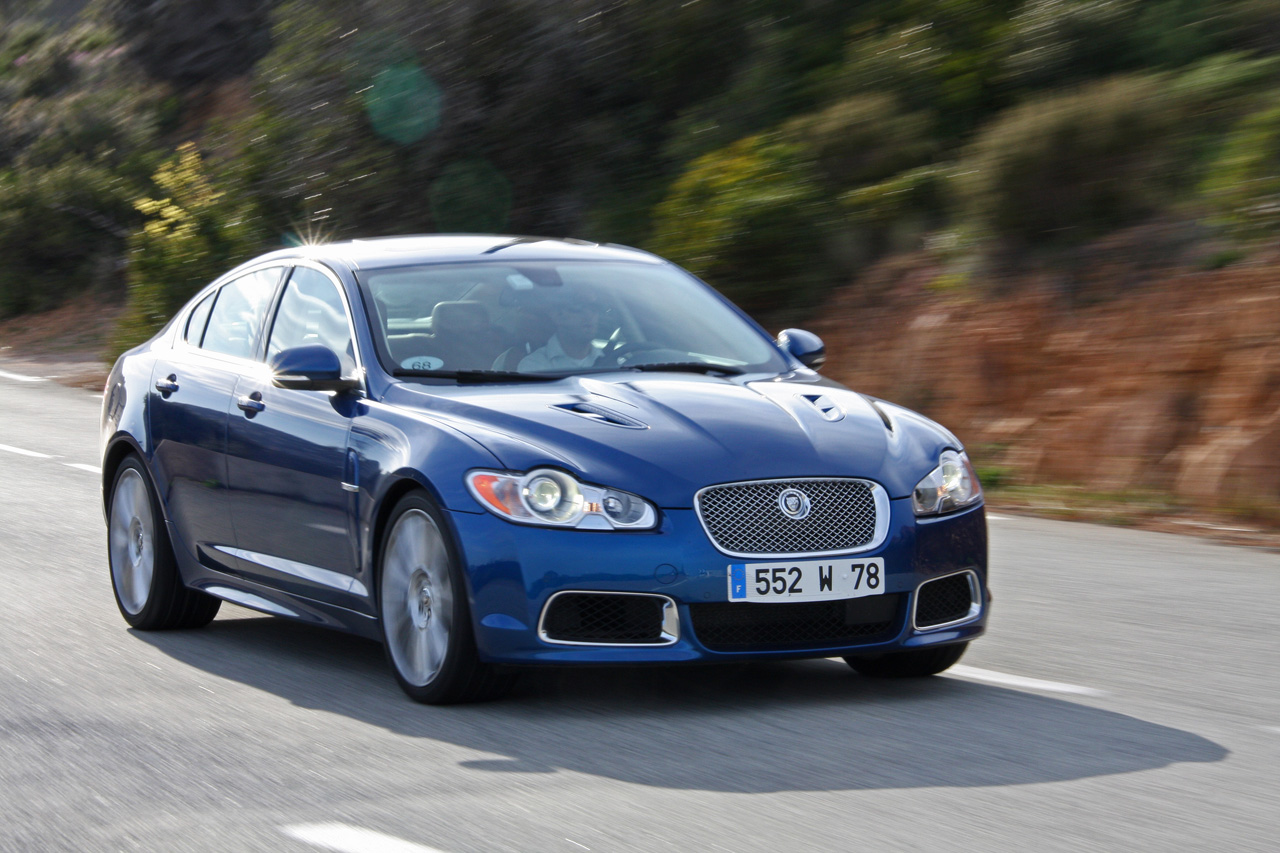
Jaguar XFRJaguar XFR

A saloon with the soul of a Jaguar sports car, the XF has won accolades and enthusiastic fans across the globe for its dynamic abilities and dramatic looks. Advances in lighting technology have allowed the new 2012 Jaguar XF model range to adopt the bold Jaguar design language introduced on the flagship XJ saloon.
Sheetmetal revisions to the grille, bonnet and front wings incorporating new triangular side vents give the car a more muscular, purposeful appearance. The range-topping Jaguar XFR receives its own unique, overtly assertive design to underline its performance potential while an alternative 'Aerodynamic' option is available on all other derivatives for a total of three dramatically different styling options.


The headlamps now incorporate bi-function HID xenon technology that allows them to be much slimmer and more compact while still providing outstanding beam resolution. They also incorporate LED daytime running lights arranged in a distinctive Jaguar 'J-Blade' signature pattern for instant recognition.
The tail lamps have been entirely renewed and now extend onto the central portion of the boot lid. These new units are now full-LED for stop, light and indicator functions and give the Jaguar XF a distinctive night-time rear signature. Separating them is a revised boot lid finisher with a gloss black lower edge for a cleaner appearance. The boot also features power closure on all models.

Jaguar XJ

The original XJ was the last car designed by Jaguar founder Sir William Lyons and the latest car to wear the nameplate is as innovative, beautiful and desirable as its famous forebear.
Revolutionary, not evolutionary, the Jaguar XJ is truly a product of the 21st century and is the clearest indication yet of the singular sense of purpose behind Design Director Ian Callum's vision for the future of Jaguar.
The unique full-length panoramic glass roof that floods the cabin with natural light allows the Jaguar XJ to offer an unrivalled sense of spaciousness and occasion for driver and passengers and at the same time retain the sleek coupé-like profile and lithe stance for which Jaguars are famous.
Lightweight aluminium architecture

The mould- breaking styling is matched by similarly impressive construction techniques pioneered by Jaguar. The lightweight aluminium structure - 50 percent of which is made from recycled materials - offers improved fuel consumption and reduced emissions. In conjunction with a lifecycle approach to design and manufacture this allows the Jaguar XJ to minimise its carbon footprint.
The weight saved by the use of aluminium - an average of 150kg compared to its rivals - also has benefits for performance and agility and is complemented by the most advanced, powerful and efficient Jaguar powertrains ever. The choice of engines has been enlarged for the 2012 range with the fitment of a 3.0-litre V6 petrol engine (market specific). All engines are coupled to a shift-by-wire, six-speed automatic transmission controlled by the JaguarDrive Selector or steering wheel-mounted paddles.

The cabin of the Jaguar XJ blends elegant, contemporary design with the comfort, luxury and unmistakable sporting style of a Jaguar. Chrome and piano black detailing provides an eye-catching contrast to the beautifully-crafted leather and wood veneer surfaces. Both standard and long-wheelbase models are available, for an even more sumptuous and refined experience for rear seat passengers.
Advanced new technology has allowed Jaguar's interior designers to create an environment more akin to a state-of-the-art living space than a car cabin. Stunning 12.3-inch high-definition virtual instruments complement an innovative Dual-view 8-inch Touch-screen that allows the passenger to view DVD movies or TV programmes while the driver is provided with vehicle functions or satellite-navigation directions.
Premium surround sound options include the top-of-the-range 1200W Bowers & Wilkins system that is comparable in audio quality to the best in-home entertainment. Advanced infotainment features also include hard-drive based audio and navigation systems and comprehensive connectivity for portable audio and video devices via the powerful Media Hub.
2012 enhancements

Subtle enhancements to the cabin are now available for the 2012 XJ range to allow greater personalisation and flexibility of use. A new Rear Comfort Pack offers seats that now feature electric adjustment of the backrest recline angle, four-way lumbar support and a massage function. Increased comfort is also provided by new winged headrests, footrests and the ability for the front passenger seat to be stowed away forwards when unoccupied to increase legroom even further.
On the long-wheelbase Portfolio derivative a new 'Executive Pack' transforms the rear of the Jaguar XJ into a high-speed mobile office space with the provision of fold-down laptop trays and an electric rear sunblind for increased privacy. The package also includes upgraded carpeting, combination wood and leather steering wheel, gloss wood veneer choices and chrome mirror housings.
Jaguar has always listened closely to customer feedback and in the case of the Jaguar XJ, this has led to a new interior colour combination. Available with the Premium Luxury and Portfolio trim levels the Jet/Ivory option features ivory seating with contrast jet stitching, piping and upper surfaces while the headlining is available in either colour, according to customer preference.
All Jaguar XJ variants are now available with an Illumination Package derived from that offered as standard on the Supersport model. This comprises illuminated treadplates, boot latch and front and rear air vents.
"An XJ should be the ultimate in comfort, design and refinement. The bespoke interior changes we have incorporated for the 2012 model make it an even more special car to drive or be driven in." Ian Callum, Design Director, Jaguar Cars

Selasa, 19 Juli 2011

Chevrolet Camaro ZL1

The 2012 Chevrolet Camaro ZL1 debuted at the 2011 Chicago Auto Show. It is the highest-performing Camaro and the most technically advanced car ever developed in its class. The new ZL1 continues the momentum of Camaro, propelling it into an entirely new realm of leading-edge performance technology. It is planned to launch at the beginning of 2012.
Motivated by a supercharged V-8 engine producing an estimated 550 horsepower (410 kW), the Camaro ZL1 will be the fastest Camaro ever offered by Chevrolet. And more than just power, the ZL1 features technologically advanced and highly developed chassis and suspension systems that help it deliver balanced, track-ready handling and braking power to complement its high engine output. Rigorous development of the ZL1 is ongoing, and official estimates of the car’s capabilities will be released later in 2011, as testing nears completion.
“Camaro ZL1 is about high-tech performance and design, and is a type of car no one has ever brought to this segment previously,” said Rick Scheidt, vice president of Chevrolet marketing. “It’s the most technically advanced Camaro ever, so we’ve chosen a name from the most elite and exclusive Camaro in history.”
The ZL1 name is derived from the all-aluminum racing engine of the same name, which was developed in the late 1960s and installed into a handful of regular-production 1969 Camaros. Only 69 were built with the engine, but they’ve achieved mythical status among enthusiasts, as they represented the pinnacle in Camaro performance – until now. The 2012 ZL1 model is designed to be a major leap forward for the Camaro, bringing a new level of performance capability to the segment.

The central goal of the car’s development was creating something new – a Camaro intended to reach optimal lap times on top road-racing circuits and excellent driving dynamics on the street. To achieve that goal, engineers evolved many of the existing Camaro’s systems, as well as incorporated new technologies such as electric power steering and Magnetic Ride Control, the world’s fastest-reacting suspension system.
Camaro ZL1’s design communicates and supports its performance mission. Rather than using decorative elements, ZL1 is visually differentiated from other current Camaro models with elements vital to the car’s elevated capabilities.
“Everything about the ZL1’s design is directly related to its technology and serious performance, especially aerodynamics,” said Ed Welburn, vice president, Global Design. “Our designers’ goal was to execute that function-oriented design with beautifully sculpted forms, creating an imposing, powerful persona. Function becomes the aesthetic. The intent is a car that delivers on the attitude it projects.”
Major elements of the ZL1’s design are a new front fascia and hood with air extractors, designed in tandem to create aerodynamic downforce to aid handling. The car’s hood includes a signature center section constructed of carbon fiber and rendered in satin black finish. New rocker panels, wide tires, 20-inch wheels and exhaust tips portray the car’s handling and power.
The ZL1 badge appears on the grille, hood and the brake calipers, all key areas portraying the technology within.
Tech overview.
Supporting the dynamic track and street performance of the ZL1 is the LSA 6.2L supercharged engine, which will produce an estimated 550 horsepower (410kW) and 550 lb.-ft. of torque (677 Nm), with specific features for the Camaro. Built on GM’s legendary all-aluminum, small-block V-8 architecture, the LSA features an intercooled supercharger system, premium heat-resistant aluminum-alloy cylinder heads and other details designed to ensure its exceptional performance is delivered with smoothness and refinement. Components and design elements that contribute to the LSA’s performance include:
• Balanced, lightweight reciprocating assembly
• High-strength hypereutectic pistons
• Sixth-generation Eaton supercharger with four-lobe rotors
• Piston oil squirters.
Because the Camaro ZL1 uses electric power steering, the engine does not incorporate a conventional hydraulic power steering pump on its accessory drive system. This enhances performance, because no engine power is used to turn a steering pump pulley.
Camaro ZL1 is a complete high-performance car, not just a Camaro with more power. Key technical highlights include:
Transmission – The high-performance Tremec TR-6060 six-speed manual is matched with the LSA engine. It is the “MG9” version of the transmission, with a higher torque capacity. It is used with a dual-mass flywheel and twin-disc clutch for easy operation and shift smoothness. A new, shorter-throw shifter actuates the gear changes.
Exhaust – ZL1 is equipped with a dual-mode exhaust system, which alters the sound level and character in response to engine rpm. First used on the legendary Corvette, and specifically tuned for Camaro ZL1, the dual-mode exhaust will give the car a signature sound.
Drivetrain – It is revised with a stronger driveshaft and rear axle system, featuring a larger and stronger cast iron differential housing, stronger axles and heavy-duty limited-slip differential. This patent-pending system is designed to ensure that ZL1’s tremendous power is delivered smoothly to the ground.
Suspension – The suspension features completely revised tuning and the inclusion of segment-exclusive Magnetic Ride Control. ZL1’s Magnetic Ride system will include driver selectable modes (Tour and Sport) tailored for the preferred style of driving. It uses advanced magneto-rheological science to produce shock damping with the highest level of precision, enabling body control optimized for excellent performance in everyday driving as well as track situations. This technology appears on only a small roster of some of the world’s finest performance cars. Other chassis elements are redesigned to support the car’s high-performance limits. Rear stabilizer bars have drop links repositioned outboard of the control arms. This makes the bars more effective in controlling body roll in turns, with crisp response to driver commands.
Brakes and Steering – Camaro ZL1 features an advanced track-capable braking system, developed in conjunction with experts from Brembo. The large 14.6-inch (370 mm) two-piece front rotors have six-piston calipers; the 14.4-inch (365 mm) rear rotors have four-piston calipers. ZL1 marks the entry of a new electric power steering system to Camaro. It is being developed to ensure precise control and feedback to the driver, with greater variability of effort for high-performance driving.
Exterior – ZL1’s signature from the front is the redesigned fascia and aluminum hood with a raised, carbon fiber insert. The fascia includes a front splitter and new vertical fog lamps. The fog lamp area includes air intakes designed for brake cooling. The hood features front-mounted air extractors that direct air precisely over the car. Visually, this center section, in satin black carbon fiber, communicates the car’s high-performance intent as a visual contrast to the car’s exterior color. Functionally, the air extractor is a key in connecting airflow closely to the bodywork, creating aerodynamic downforce. The carbon fiber center section reduces the mass of the hood. High-intensity discharge (HID) headlamps and fog lamps are standard. The rear of the car includes a diffuser and spoiler, also functional elements that enhance the car’s aerodynamics.
Wheels and Tires – New-design, 20-inch forged aluminum wheels, which are lighter than the 20-inch wheels used on the Camaro SS, are used with new Goodyear Supercar F2 ties developed specifically for the ZL1.
Interior – ZL1 is tailored for high-performance driving. The front seats feature microfiber suede inserts. Other enhancements include a redesigned steering wheel, alloy pedals, Head-Up Display with unique performance readouts and the “four-pack” auxiliary gauge system featuring a boost readout.
Production details.
All of the Camaro exterior colors will be offered with the ZL1, but black is the only interior color. The unique exterior features are complemented with a black center section on the hood. Inside, the Camaro ZL1 has heated leather seats with microfiber inserts and ZL1 logos embroidered on the front headrests. Microfiber suede is repeated as an accent on the instrument panel, adding a richer look to the interior. The ZL1 will include the same content as the current 2SS package and include the following new or unique features:
• Six-way power driver and passenger seats
• Unique instrument panel and door panel inserts; and ZL1-logo sill plates
• Steering wheel audio controls with Bluetooth capability
• Wireless PDIM and USB-port
• Boston Acoustics premium audio system
• Rear parking assist
• Rear camera system (displayed in the inside rearview mirror).
Engineers have already driven Camaro ZL1 prototypes extensively at demanding road courses in the U.S. and Germany, with final testing being completed through the balance of 2011.